The Bagrada hilaris female had been its usual self during the first several days of January, though refusing to stay planted on its food after eagerly proboscising it; another few days later it was deader than a bag of cricket flour.
I am quite appalled, since I suspect that there may have been a problem with hostplant quality; many specialist oligophagous herbivores are prone to mysterious tantrums if they smell that a particular host is excessively well-defended or lacking in nutrition. I imagine it could have been easily averted by providing a wider selection of different brassicaceans to it each day, since this has worked well in the past when it probed and rejected one leaf or floret. Unfortunately, my now-constant lack of sanity (and thus energy) had been causing some problems with plan implementation and furthermore I could not have released the poor hemipteran anyways; why are brassicacean weeds always rare when you really need them? I am tired of detecting potential ethical disasters and consistently failing to avert them despite frantic efforts.
In any case r-strategists are built for high mortality rates anyways; I suppose I can tentatively hope that whatever I did to it is less unpleasant than its natural fate...? After all despite the frequent broccoli shortages I did fish it out of the swimming pool and allow it to live several months longer than wild specimens (which I presume are literally annoyed to death by heapfuls of desperate males on a regular basis). Those broccoli shortages were still awfully long, though.
Fortunately the Pomacea diffusa specimen is still doing quite well, though it hasn't stopped fasting yet.
Monday, January 13, 2020

New Year's "fireworks"

Introduction
Unfortunately, my recent research strongly seems to imply that Physciella chloantha can only grow several millimeters each year even under extremely frequent hydration; fortunately, since "adult" chloantha thalli are naturally rather small this means that under such a growth rate there will in fact be a significant proportional increase in their size after several years. Unfortunately, it is still a rather slow growth rate, although at least it is faster than that of many non-synanthropic lichens.
Fortunately, some lichens still grow much faster than chloantha. These include the "obligately" foliicolous ephemerals (more on that later), but also some larger-bodied types such as Peltigera and Herpothallon (sidenote: Peltigera is one of the few lichens that have successfully been grown as a non-axenic whole thallus indoors; Moss Grower's Handbook reports that it pops up occasionally in cultivated moss setups as a very minor pest).
Death and tax(onomi)es
Hazel of Hazel's Science Things has been generous enough to supply me with a number of lichens freshly imported from Florida and Ohio, and among the most notable is the red and mint-green thing pictured above and below (interestingly it stays green even when dry):
 |
| the pointy things are true mosses |
I am currently waiting for a third opinion on the matter.
Herpothallon rubrocinctum: an ecological overview
Available evidence gives me the strong impression that any possibly-confusable species are only other Herpothallon; thus, they have some probability of being ecologically similar.
Information on rubrocinctum habitat appears to be surprisingly sparse in the scientific research literature; it seems to be one of the poster children of lichenworld, presumably due to its bright coloration, and is frequently mentioned on nature sites targeting non-researchers. Other lichenized members of the Arthoniaceae are normally drab in color, barely recognizable as lichens or even live organisms to the untrained eye, and receive essentially no attention from anyone at all; they appear to be equivalent to the tiny brown beetles and parasitoid wasps which tormented entomologists mention using phrases like "hostplant unknown" and "genus revision desperately needed; multiple undescribed cryptic spp. present". Ironically, I do not perceive rubrocinctum as beautiful in coloration; since color-based attractiveness seems to be controlled by modifiable instincts (perhaps the fruit-seeking ones? I'm not a psychologist) and is apparently not an inherent/objective property of objects, I appear to have accidentally trained my subconscious mind to associate only muted color palettes with prettiness. Spending massive quantities of time looking at drab tenebrionid/carabid beetles has some bizarre side effects, I guess! (Not that I care either way, since I am mostly just interested in extracting science from the thalli.)
After a brute-force scan of every rubrocinctum paper in existence(!) on Google Scholar, I have assembled a tentative map of its preferences:
- Colonized substrate known to include a wide variety of native and non-native bark/mosses (the pictured thallus is in fact smothering the mosses to death), but also rarely rock and angiosperm leaves; I imagine it is theoretically capable of colonizing plastic, like many other foliicolous lichens. (NOTE: I have previously suggested that Physciella chloantha may also be plastic-colonizing due to its ability to grow on top of mosses; however, since I have never seen reports of it growing on angiosperm leaves or plastic in the wild, and it seems intolerant of extreme smoothness, if it can grow on plastic special conditions are likely needed to help it hydrate and attach properly.)
- It is widespread throughout the humid tropics, although it may rarely also occur in the dry zones of such areas; one paper reported it was present even on several environmentally degraded farmland areas. Another reported that it was extremely water-repellent, likely to prevent drowning during heavy rains. An illustration within mentioned that the exposed thallus surface is superhydrophobic; conversely, the side in contact with the bark is riddled with a complex network of channels to collect and rapidly drain water. My own observations confirm the repellence; specimens appear to dry out quite quickly even compared to other lichens despite thorough spraying. Finally, a third paper mentions that Floridian specimens it studied had constant 24-hr access to water except for a few hours at noon; I will try to keep my specimens constantly sprayed whenever the sun is active (lichens can't photosynthesize in darkness anyways, so inducing nighttime dormancy should probably save energy).
- A few papers mention that it has been found on acid bark, although I could not find if it prefers acidity or merely tolerates it; I did not see any reports mentioning its presence on neutral or calcareous substrates. Hazel reports that the hostplant of the ones sent to me is Quercus (oak), which is indeed acidic unless it has been calcified by aerial dusts. To be safe I will be watering it and all the other Florida lichens (the local region apparently has acidic rain) with distilled mineral-free water; if what a paper told me about bark pH is correct, then the bark acids will acidify neutral water applied to it.
Unrelated bonus paper
https://www.researchgate.net/publication/231794852_A_new_species_of_Arthonia_is_a_pest_in_an_orchid_nursery
As mentioned above, many Arthonia (including this one) are nondescript mold-like films. Do note that in the back it mentions several other lichens naturally occurring or successfully cultivated in greenhouses.
Friday, December 27, 2019
Holiday update
 |
| zzzzzzzzz |
The Pomacea diffusa specimen has survived temperatures slightly below 65F° and continues to survive. It shows little interest in hiding or investigating the plastic plant I put in its jar for psychological enrichment purposes; it has also ceased to feed entirely or almost entirely, having evidently entered full-power overwintering mode. I may offer it a cave; perhaps it will be deemed more suitable than the counterfeit angiosperm?
Friday, December 13, 2019
Physciella chloantha coughs up several surprises ( + bonus algae)

I have pulled out some lichen thalli and am attempting to keep them on plastic to isolate them from the mold and arthropods, but several turned brown within hours (death via mechanical injury?).
Here are microscope pics of some bonus green algae (and possibly some barely visible lichen threadlets) I pulled off a parking lot tree. The lichenologist thought the former were Lepraria/Leprocaulon lichens until seeing algal cells swim around during hydration.


Wednesday, December 11, 2019
More lichens, part 2

Here are some other synanthropic lichen specimens located in "my" yard; they are currently waiting for the lichenologist's ID. Interestingly, the black palm tree dots are largely restricted to areas of injured bark carved into a pattern by some dumb vandal long ago; furthermore, they do not change color when wet (the gray palm dots and probably also persimmon dots turn green like chloantha in the rain).
 |
| gray dots from persimmon |
 |
| black palm dots |
 |
| gray palm dots |
Tuesday, November 26, 2019
Introducing Pomacea! (also, small Bagrada update)

I involuntarily acquired the watersnail last month after an unfortunate series of events involving an irresponsible buyer and subsequent month-long fasting session for it. So far, its physical health appears to have improved since I began rehabilitation efforts; a crackly pale growth ring (presumably from the fasting period) I saw on it has been followed by some more normal-looking deposits of shell. However, it appears to have become somewhat dormant in the current cold weather; it refuses to ingest whole vegetables and will sporadically eat somewhat large quantities of algal wafer (which contain few algae and lots of green food coloring + starch). This also makes it quite a boring specimen, as it spends all its time sleeping, feeding, or travelling aimlessly. I doubt it will become less boring during the spring though, except for sleeping less and eating more.
I am rather concerned for its future safety and psychological health, though. While outdoor air temperatures here never get cold enough to kill all the cold-intolerant bugs, they are cold enough to induce in me constant sneezing (and are also below the reported thermal tolerances of diffusa). The situation indoors is of course somewhat better, but in the past it has nearly approached below 65 deg Fahrenheit (the danger zone). My deceased flightless Cotinis mutabilis male (rest in peace) was not harmed by them, but water is usually colder than the surrounding air. I am also stuck with a relatively small jar for housing it, since my juvenile koi specimens would likely harass or outcompete it to death if I threw it in their tank; this means there are no dark hiding areas for it. I am not sure if Pomacea absolutely require hiding areas to prevent stress, like carabids/tenebrionids, but it often drops to the bottom of its jar (a defensive maneuver) if I turn on excessively bright lights at night.

Thursday, November 21, 2019
Bagrada hilaris drinks the last of my defrosted broccoli

Wednesday, November 20, 2019
More lichens, part 1
What we had previously thought was Phaeophyscia hirsuta is actually Physciella chloantha! All my old commentary about hirsuta still applies though, except that chloantha is definitely not under conservational danger. The lichenologist I sent my samples to has declared that chloantha is rarely collected from California; mine is the first ever record from Los Angeles County and also highly unusual for being on an eucalyptus tree! Clearly lichens are just as scientifically unpopular as bugs; how else could a popular park filled with tons of chloantha escape researcher attention?
By the way, the chloantha samples I kept for cultivation purposes all developed moldy smells, despite the thalli appearing quite healthy; I had to throw them out. The wild yellow tree lichens suffered a similar fate, except that I was unable to throw out the tree. Even the lichenless tree parts smell terrible when moistened; how is a living branch growing mold?
Here are some microscope pics of chloantha the lichenologist sent me and gave permission to use; as mentioned before, gray thalli are dry and turn green seconds after hydration.


By the way, the chloantha samples I kept for cultivation purposes all developed moldy smells, despite the thalli appearing quite healthy; I had to throw them out. The wild yellow tree lichens suffered a similar fate, except that I was unable to throw out the tree. Even the lichenless tree parts smell terrible when moistened; how is a living branch growing mold?
Here are some microscope pics of chloantha the lichenologist sent me and gave permission to use; as mentioned before, gray thalli are dry and turn green seconds after hydration.


Fun misadventures with the Brassicaceae

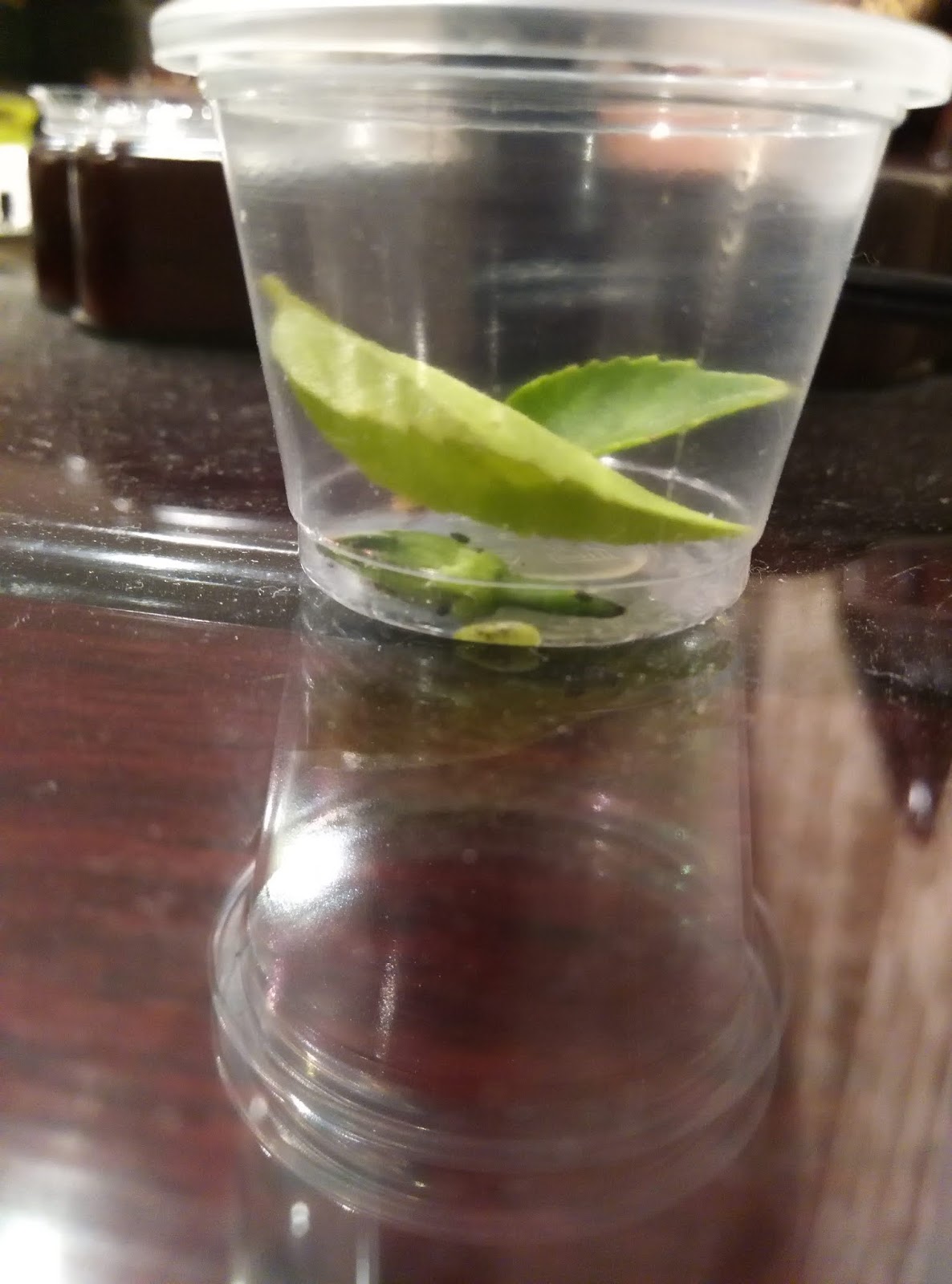
In addition to the four caterpillars mentioned previously and shown above, I also later found a brown cutworm-shaped one in a different brassicacean bag and caught two starving Bagrada hilaris females to accompany all of the caterpillars. Unfortunately, the second female ran off and died one day when I was replacing their food; the first one is still doing well today and has apparently become somewhat habituated to my presence. At least I gave the deceased one a few extra meals before it died...? Sigh.

On October 14, two parasitoid wasp larvae emerged, finished off their hosts' green corpses by eating from the outside in, and then began vigorously silking the floor.
 |
| the parasitoids appear to be conspecifics too |

Several more days later, they continued drooling silk without pupating. I was getting slightly worried, as they had somehow drooled a whole ring around the cup edge despite being seemingly incapable of voluntary locomotion. Fortunately, all of them finally turned into wasp pupae after I put a large quantity of paper inside to serve as silk anchor points.
Several days later after that, the brown caterpillar was motionless. I thought the decaying broccoli gases had killed it, but another wasp larva exited the corpse.
 |
| brown larva, before demise |
Unfortunately, I could not rear any of the wasps correctly. The green caterpillar parasitoids failed to eclose from their pupae properly, and I fed them to vertebrates out of pity. The syrphid(?) puparium produced a correctly shaped wasp though. It died before I saw it; perhaps it was too entangled in the others’ silk?
 |
| adults (note odd abdomen) |
Wednesday, October 9, 2019
I almost ingest some extra protein
 |
| lepidopteran x4 |
Several days ago I was washing some brassicacean foliage for dinner. To save time, let us just skip to the conclusion (see above/below):
 |
| syrphid(?) x1 |
The caterpillars have window-fed from several brassicacean leaves and have visibly enlarged already. I am currently transitioning them to defrosted broccoli (which is also brassicacean), as you can see in the picture. They spend large quantities of effort tying down the leaves with silk and then sleep for long periods under them; actual feeding occupies a relatively small portion of the day. Rather amusingly, they appear incapable of recognizing conspecifics as harmless and thus engage in long panicky headbashing contests whenever one manages to make contact with another.
The syrphid(?) maggot has ingested at least two aphids, but it appears to be even more torpid than its herbivorous counterparts. It appears to have occupied a largely stationary position soon after aphid one! Despite said position being next to a whole budful of aphids it did not seem to have even attacked any until I manually woke it up for #2 (the rest of the poor aphids, though completely oblivious to the threat, were at this point quite alarmed that their hibiscus bud was wilting; I released them back into the garden).
Hopefully I will be able to rear all five to adulthood, since there is a chance they may be newly imported species.
Friday, September 27, 2019
A yellow lichen has died
This one turned crumbly before falling off its tree:


Its orange neighbors (see my featured post) seem fine though.
EDIT: all members of its morphospecies have apparently vanished from areas where I have been watering the branches, but one thallus I kept dry as an experimental control appears fine.
Subscribe to:
Posts (Atom)