Showing posts with label Diptera (generic). Show all posts
Showing posts with label Diptera (generic). Show all posts
Wednesday, August 21, 2024

Tuesday, April 25, 2023
Followup to below
I've been seeing large aggregations of various synanthropic native and invasive aphidophages (golly gee, what a lot of adjectives) in the wilderness, but only near weedy mustard megaclusters. Presumably they are murdering various mustard aphids.
More "pristine" habitat remains low in insect density, with a few exceptions.
Tuesday, December 20, 2022
Nonvisual flight in a chironomid?!
https://doi.org/10.1371/journal.pone.0152884
Visually unmediated flight is one of those things one expects insects to evolve regularly but which seems to be almost nonexistent for some reason (even Tenebrionidae have larger eyes in flighted than flightless species, said some paper I'm too lazy to refind).
Addendum, 12/21: I also suspect some (perhaps even most) epigean Tipulidae may be capable of flying more or less correctly if experimentally blinded.
Saturday, August 22, 2020
Diaperis rufipes, 2020 season

Unfortunately as with previous years the only other dominant visitor to the fungus is a certain nondescript brown fly that seems to be a lauxaniid, with the rest being a very few species of boring generalist earwigs, gnats, slugs, etc.
Last night I spotted my first living rufipes adult and took it in for some photos. Unsurprisingly my idiot phone AI decided to mess with me again, even under bright light it insisted the red stripes were black and refused to focus despite being perfectly capable of doing so, so I'm not going to post most of those pics here.
However I have captured a single pic of it with flared wings (and thus proved it isn't flightless) and visible red, and this is undoubtedly the only photograph of it doing so in existence!

Like I said previously, it is (like most other longwinged tenebrionids) extremely unwilling to fly and cannot be induced to do so unless malnourished and attempting dispersal, so instead I turned it upside down and photographed it when it spread its elytra to right itself.

Wednesday, November 20, 2019
Fun misadventures with the Brassicaceae

In addition to the four caterpillars mentioned previously and shown above, I also later found a brown cutworm-shaped one in a different brassicacean bag and caught two starving Bagrada hilaris females to accompany all of the caterpillars. Unfortunately, the second female ran off and died one day when I was replacing their food; the first one is still doing well today and has apparently become somewhat habituated to my presence. At least I gave the deceased one a few extra meals before it died...? Sigh.

On October 14, two parasitoid wasp larvae emerged, finished off their hosts' green corpses by eating from the outside in, and then began vigorously silking the floor.
 |
| the parasitoids appear to be conspecifics too |

Several more days later, they continued drooling silk without pupating. I was getting slightly worried, as they had somehow drooled a whole ring around the cup edge despite being seemingly incapable of voluntary locomotion. Fortunately, all of them finally turned into wasp pupae after I put a large quantity of paper inside to serve as silk anchor points.
Several days later after that, the brown caterpillar was motionless. I thought the decaying broccoli gases had killed it, but another wasp larva exited the corpse.
 |
| brown larva, before demise |
Unfortunately, I could not rear any of the wasps correctly. The green caterpillar parasitoids failed to eclose from their pupae properly, and I fed them to vertebrates out of pity. The syrphid(?) puparium produced a correctly shaped wasp though. It died before I saw it; perhaps it was too entangled in the others’ silk?
 |
| adults (note odd abdomen) |
Wednesday, October 9, 2019
I almost ingest some extra protein
 |
| lepidopteran x4 |
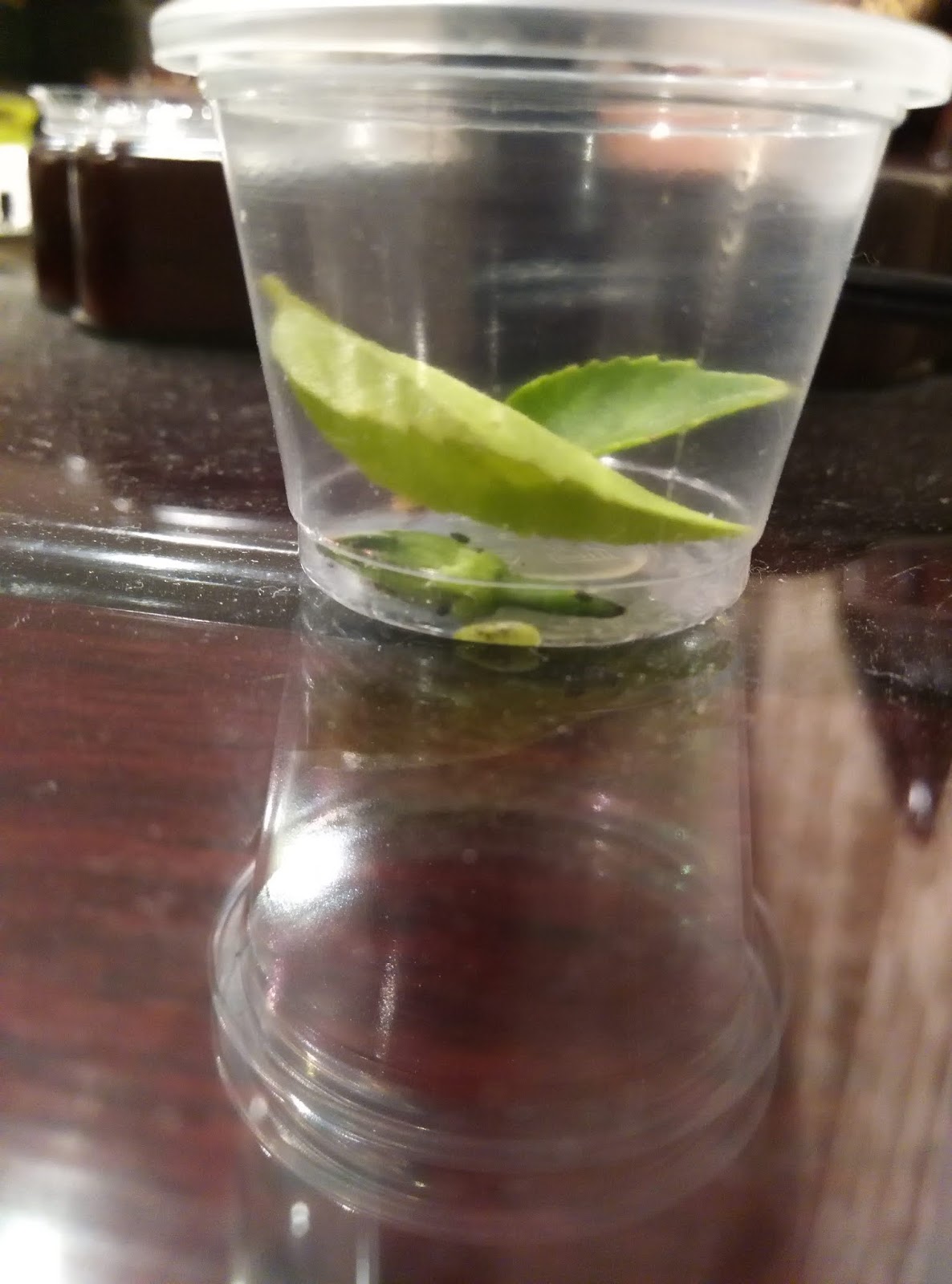
Several days ago I was washing some brassicacean foliage for dinner. To save time, let us just skip to the conclusion (see above/below):
 |
| syrphid(?) x1 |
The caterpillars have window-fed from several brassicacean leaves and have visibly enlarged already. I am currently transitioning them to defrosted broccoli (which is also brassicacean), as you can see in the picture. They spend large quantities of effort tying down the leaves with silk and then sleep for long periods under them; actual feeding occupies a relatively small portion of the day. Rather amusingly, they appear incapable of recognizing conspecifics as harmless and thus engage in long panicky headbashing contests whenever one manages to make contact with another.
The syrphid(?) maggot has ingested at least two aphids, but it appears to be even more torpid than its herbivorous counterparts. It appears to have occupied a largely stationary position soon after aphid one! Despite said position being next to a whole budful of aphids it did not seem to have even attacked any until I manually woke it up for #2 (the rest of the poor aphids, though completely oblivious to the threat, were at this point quite alarmed that their hibiscus bud was wilting; I released them back into the garden).
Hopefully I will be able to rear all five to adulthood, since there is a chance they may be newly imported species.
Wednesday, September 25, 2019
Placatory feeding: an overview
 |
| Cotinis mutabilis being placated |
Introduction
Unlike many vertebrates, insects and other arthropods often fail to react strongly or at all when they perceive danger. This can result in surreal scenarios; aphids can often be seen right next to sleeping coccinellids, and may even attempt to climb onto their shells! Furthermore, even normally wary taxa may calm down instantly after encountering food, and then become quite oblivious. This is often useful during photography, as feeding specimens generally cease to move.
Chart legends
Placatability:
H = highly placatable; specimens lose nearly all fear when they are fed
OH = often highly placatable; specimens lose nearly all fear when successfully fed, but sometimes may refuse food
S = somewhat placatable; specimens will refuse food when extremely alarmed, and lose some/most fear after successful feeding
F = placatable when force-fed; alarmed specimens will ignore food if they can flee; if they cannot flee, they will feed and calm down. Note that some highly placatable taxa refuse food only when force-fed, and some highly non-placatable taxa always accept it when force-fed.
R = rarely placatable; specimens normally do not accept food when alarmed. However, slightly moribund specimens may sometimes feed (note that heavily moribund insects usually refuse all food, even if normally highly placatable)
N = not placatable
Primary tasting organs:
These elicit strong feeding responses when the insect contacts a food source with them, if it is not sufficiently frightened. Note that many insects are poor at locating food and will only notice it if their primary tasting organs accidentally collide with a food source.
A = antennae
P = palps
L = legs
Placation chart, arranged by taxon
Note that I am unfamiliar with the behaviors of certain taxa, and these may be excluded or contain less accurate ratings. I have based this on local species; your results may vary. Morphologically anomalous species are excluded for convenience. Assume only adults/adultlike young are being discussed, unless otherwise indicated.
ORDER Coleoptera
- Tenebrionidae (adults/larvae): S or OH, A, P
- Elateridae: H, A?, P?
- Carabidae: OH, P; nocturnal spp. may eat in daylight
- Coccinellidae (all): OH, sometimes F, either or both A, P
- Scarabaeidae, Melolonthinae: R, P
- Scarabaeidae, Cotinis mutabilis: OH, P
- Chrysomelidae (adults/larvae): R?
- Melyridae, Collops quadrimaculatus(?): H?, P, A?
- Staphylinidae: R?
ORDER Hymenoptera
OH, A, P, sometimes S, F
ORDER Lepidoptera
- Larvae: either OH or S; primary taste-organs unclear but around mouthparts
- Adult moths, if not mouthless: H, A?, L
- Adult butterflies: OH if F, A? L
ORDER Hemiptera
- Hoppers: N
- Aphids: OH?
- Heteropterans: R, L, A?; however sometimes herbivorous spp. attempt to probe skin
ORDER Zygentoma
- Synanthropic silverfishes: R, A? P?
ORDER Embiidina
S, A?, P? Adult males cease feeding after eating the final molt.
ORDER Blattodea
- Roaches: am unfamiliar, but based on reliable reports from others: OH (at least some), A, P
- Termites: apparently N
ORDER Orthoptera
Highly variable between species; possibilities include OH when F, N, A?, P
ORDER Diptera
- "Classic" (large-eye) flies: OH when F, L
- Gnat/mosquito/midge-shaped: H when F, L, P
- Crane flies: OH when F, P
- "Classic" maggots: OH? Apparently almost completely fearless.
ORDER Neuroptera
- Green lacewings: H when F, P, A?
ORDER Araneae
Salticidae: S? Some species appear completely fearless, H for these
Other free-living spiders: possibly S/R
Obligate web-hunting spiders: N, but Gasteracantha and several others known to OH even when webless
ORDER Isopoda
S/R, A
Wednesday, September 4, 2019
Diaperis rufipes returns

The puffy shelf fungus is back! I found a Diaperis rufipes specimen last night. It cooperated quite nicely for the photoshoot, but my phone camera insisted on all sorts of nonsense (in several instances its AI firmly insisted that kitchen paper was in fact red!) so I don't have any pics worth sharing. At least my small-insect photographs are no longer blurry! In the meantime enjoy some closeups of the fungi and a visiting fly; I plan to do a live or semi-live timelapse video soon.
 |
| (the droplets are jelly secretions, not water) |

 |
| giant lauxaniid, apparently |
Sunday, June 30, 2019
Minor entowalk update
I have been quite busy lately, but I finally went on another entowalk in the public garden; the foliage is weedy and quite lush now, but the milkweed had only several(?) dozen unclustered Oncopeltus adults and an adult monarch.
Syrphids (mostly ubiquitous taxa like Allograpta obliqua and Toxomerus marginatus) and coccinellids are still not uncommon though; however, it seems a few Hippodamia have now been accompanying Cycloneda sanguinea.
Syrphids (mostly ubiquitous taxa like Allograpta obliqua and Toxomerus marginatus) and coccinellids are still not uncommon though; however, it seems a few Hippodamia have now been accompanying Cycloneda sanguinea.
Friday, April 5, 2019
2019 desperate spring tipulid-chase
 |
| resting male |
 |
| and female |
Over the past few weeks, the annual swarm of giant brown tipulids has been (and still is) active in my yard; on the other hand, the Vanessa public garden swarms have nearly disappeared. Having finally armed myself with a red flashlight (most insects are unable or nearly unable to see it) and a somewhat decent slow-motion camera, I was quite impatient to collect some footage for the entomology outreach campaign.
I was rather startled to see the following thing one afternoon:
I wasted quite some time trying to film them.
After finally managing to align the phone camera with the fast-flying dipterans, I realized that the videos were still too blurred to be of much use for public campaigns; still, under slow motion the animals' seemingly senseless bumbling revealed a fascinating phenomenon.
From the beginning I had suspected that they were using their vast array of legs as pseudo-antennae; though they flied quite erratically when in the fenceside weed patch, they moved with a sense of purpose, as if carefully palpating the plants for suitability. Furthermore, they often also bounced against fences in an even more chaotic fashion, but did so even in the absence of lamps (contrary to popular belief, nocturnal insects' lamp bouncing is a highly abnormal stress-behavior). Upon video slowing, the tipulid flight patterns certainly appeared to support my antennation hypothesis:
(for some reason, ground bouncing usually occurred in straight lines or arcs, unlike wall bouncing)
Further attempts at flight video capture were wholly unsuccessful, although I did manage to capture several other things.
 |
| male and tenerally pale (I think) female |
(unfortunately a planned timelapse on mating dynamics failed hilariously; during most of the filming period no additional males came, and after taking a long break I arrived just in time to see the female fly over the fence while still copulating)
Several other tipulomorph species were present, but these were not very abundant and I was barely able to observe any behaviors from them. EDIT: A while after the Large Brown swarming ceased, the first morphospecies became abundant for a few weeks. I have also seen wulpiana bouncing briefly on grass.
 |
| mottled sp. sitting on web |
 |
| Nephrotoma wulpiana, a bright orange tipulid |
Sunday, March 3, 2019
Ento-walk large post!
2/25: Bland pics
The small Sphaeralcea hemipterans have not done anything too interesting, though I did see an adult and nymph excitedly running up and down the stems for some reason I couldn't determine. I was able to find few other interesting arthropods in the public garden despite seeing many freshly and heavily chewed leaves as well as large diurnal predators; any advice?
Interestingly, several nearby honeybees were displaying an intriguing behavior; they would happily pollinate Sphaeralcea flowers that were open, but would attempt to nectar-rob closed flowers and shove themselves inside of partially closed flowers. Even more interestingly, I later saw an entire foraging party apparently nectar-robbing a bushful of dead dried Salvia flowers. Befitting for a highly adaptable synanthrope, I guess.
Here are a few other random pics I took, by the way
2/26: Not all locusts have jaws
I was rather surprised to see hilariously large Vanessa cardui swarms in the European flowers section; it seems the recent few weeks of rain here have triggered a migration. The butterflies were evidently rather famished, too; they frantically stuffed their tongues into anything that had petals, including fancy-looking cultivars which even the honeybees refused to touch. I think I once read somewhere in a technical book that Vanessa spend 90-something percent of their time nectaring, because many flowers give meals sparingly to encourage pollination. Unfortunately, my phone refused to photograph the whole swarm, so here are a few individuals:


The Tagetes lemmonii bush nearby was also quite biodiverse (its passionfruity scent was excellent too);

The small Sphaeralcea hemipterans have not done anything too interesting, though I did see an adult and nymph excitedly running up and down the stems for some reason I couldn't determine. I was able to find few other interesting arthropods in the public garden despite seeing many freshly and heavily chewed leaves as well as large diurnal predators; any advice?
 |
| large diurnal predator |
 |
| hard-working but certainly not honest |
 |
| Halictus tripartitus |
 |
| Mecaphesa trying to ambush hover flies |
2/26: Not all locusts have jaws
I was rather surprised to see hilariously large Vanessa cardui swarms in the European flowers section; it seems the recent few weeks of rain here have triggered a migration. The butterflies were evidently rather famished, too; they frantically stuffed their tongues into anything that had petals, including fancy-looking cultivars which even the honeybees refused to touch. I think I once read somewhere in a technical book that Vanessa spend 90-something percent of their time nectaring, because many flowers give meals sparingly to encourage pollination. Unfortunately, my phone refused to photograph the whole swarm, so here are a few individuals:


2/26 (cont.) and 2/27: Fun with the milkweed crew (and more)
I found a small party of milkweed hemipterans on a bunch of sickly-looking plants in the herbs section! Unfortunately, all hemipteran species had sparse populations despite plentiful seeds; perhaps only two or three adult Oncopeltus and a single adult Lygaeus were around, with a few large nymphs present. A few Aphis nerii clusters were also around but they were busy getting themselves killed.


 |
| Cycloneda sanguinea |
 |
| (can you find the aphid?) |
 |
| yellowish inchworms were abundant |
 |
| Erynnis tristis, far handsomer than the overdressed Vanessa |
 |
| these wingwiggling flies were common too; learning their sign language might be interesting |
3/7: A few more bland but interesting pics
I found my first iridoviral blue pillbug today! It wasn't very blue, though. My phone camera made it look more vibrant that it actually was; here is a heavily edited pic showing realistic colors.

Also, I have finally managed to get a non-blurry pic of this large bumblebee; although it visits several unrelated species of flower, it appears to be quite selective about its dining options (I have never seen it outside the public garden) and is extremely wary + restless.
 |
| Bombus melanopygus |
Subscribe to:
Posts (Atom)