
Thursday, November 21, 2019
Bagrada hilaris drinks the last of my defrosted broccoli

Wednesday, November 20, 2019
More lichens, part 1
What we had previously thought was Phaeophyscia hirsuta is actually Physciella chloantha! All my old commentary about hirsuta still applies though, except that chloantha is definitely not under conservational danger. The lichenologist I sent my samples to has declared that chloantha is rarely collected from California; mine is the first ever record from Los Angeles County and also highly unusual for being on an eucalyptus tree! Clearly lichens are just as scientifically unpopular as bugs; how else could a popular park filled with tons of chloantha escape researcher attention?
By the way, the chloantha samples I kept for cultivation purposes all developed moldy smells, despite the thalli appearing quite healthy; I had to throw them out. The wild yellow tree lichens suffered a similar fate, except that I was unable to throw out the tree. Even the lichenless tree parts smell terrible when moistened; how is a living branch growing mold?
Here are some microscope pics of chloantha the lichenologist sent me and gave permission to use; as mentioned before, gray thalli are dry and turn green seconds after hydration.


By the way, the chloantha samples I kept for cultivation purposes all developed moldy smells, despite the thalli appearing quite healthy; I had to throw them out. The wild yellow tree lichens suffered a similar fate, except that I was unable to throw out the tree. Even the lichenless tree parts smell terrible when moistened; how is a living branch growing mold?
Here are some microscope pics of chloantha the lichenologist sent me and gave permission to use; as mentioned before, gray thalli are dry and turn green seconds after hydration.


Fun misadventures with the Brassicaceae

In addition to the four caterpillars mentioned previously and shown above, I also later found a brown cutworm-shaped one in a different brassicacean bag and caught two starving Bagrada hilaris females to accompany all of the caterpillars. Unfortunately, the second female ran off and died one day when I was replacing their food; the first one is still doing well today and has apparently become somewhat habituated to my presence. At least I gave the deceased one a few extra meals before it died...? Sigh.

On October 14, two parasitoid wasp larvae emerged, finished off their hosts' green corpses by eating from the outside in, and then began vigorously silking the floor.
 |
| the parasitoids appear to be conspecifics too |

Several more days later, they continued drooling silk without pupating. I was getting slightly worried, as they had somehow drooled a whole ring around the cup edge despite being seemingly incapable of voluntary locomotion. Fortunately, all of them finally turned into wasp pupae after I put a large quantity of paper inside to serve as silk anchor points.
Several days later after that, the brown caterpillar was motionless. I thought the decaying broccoli gases had killed it, but another wasp larva exited the corpse.
 |
| brown larva, before demise |
Unfortunately, I could not rear any of the wasps correctly. The green caterpillar parasitoids failed to eclose from their pupae properly, and I fed them to vertebrates out of pity. The syrphid(?) puparium produced a correctly shaped wasp though. It died before I saw it; perhaps it was too entangled in the others’ silk?
 |
| adults (note odd abdomen) |
Wednesday, October 9, 2019
I almost ingest some extra protein
 |
| lepidopteran x4 |
Several days ago I was washing some brassicacean foliage for dinner. To save time, let us just skip to the conclusion (see above/below):
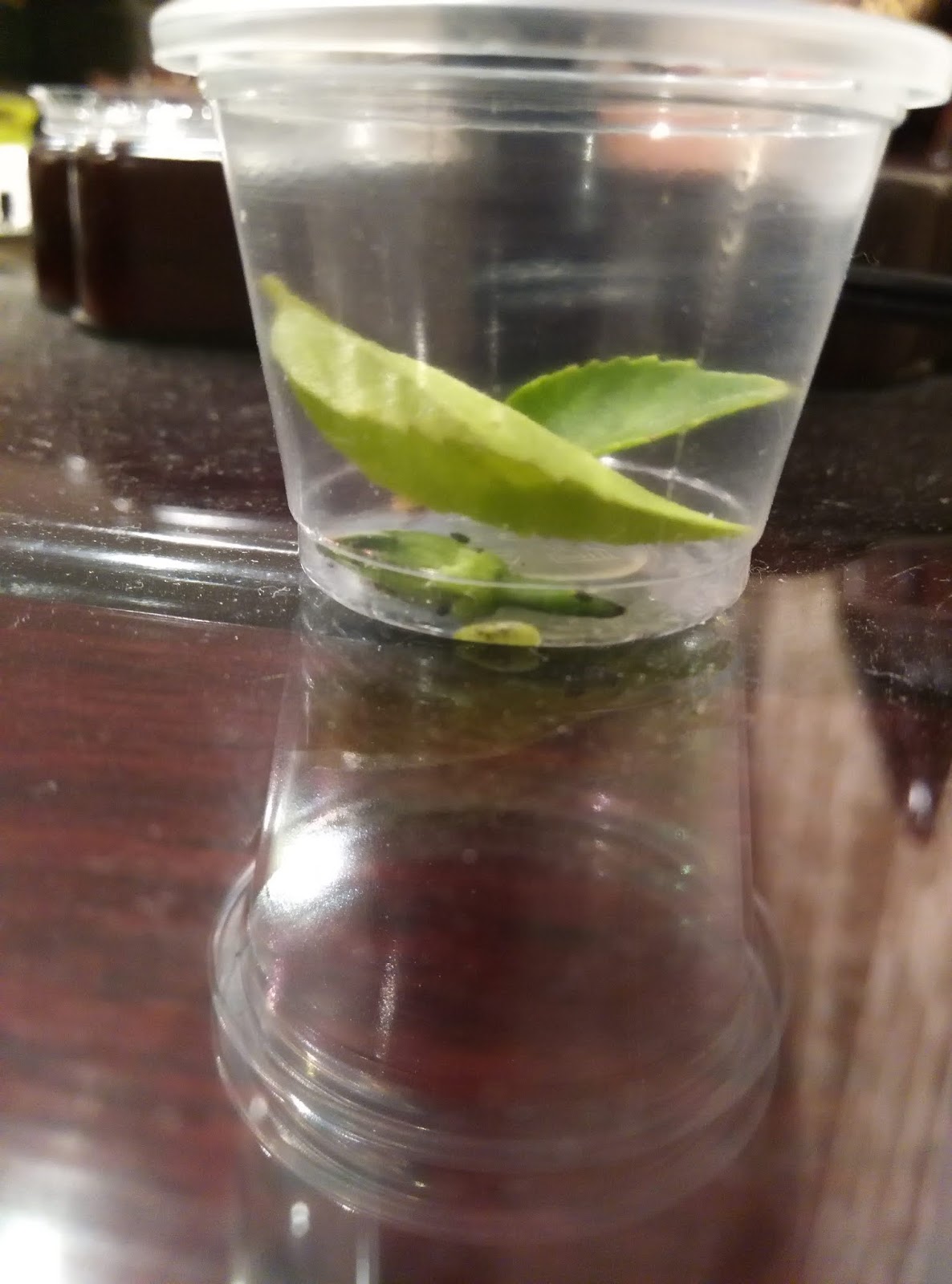 |
| syrphid(?) x1 |
The caterpillars have window-fed from several brassicacean leaves and have visibly enlarged already. I am currently transitioning them to defrosted broccoli (which is also brassicacean), as you can see in the picture. They spend large quantities of effort tying down the leaves with silk and then sleep for long periods under them; actual feeding occupies a relatively small portion of the day. Rather amusingly, they appear incapable of recognizing conspecifics as harmless and thus engage in long panicky headbashing contests whenever one manages to make contact with another.
The syrphid(?) maggot has ingested at least two aphids, but it appears to be even more torpid than its herbivorous counterparts. It appears to have occupied a largely stationary position soon after aphid one! Despite said position being next to a whole budful of aphids it did not seem to have even attacked any until I manually woke it up for #2 (the rest of the poor aphids, though completely oblivious to the threat, were at this point quite alarmed that their hibiscus bud was wilting; I released them back into the garden).
Hopefully I will be able to rear all five to adulthood, since there is a chance they may be newly imported species.
Friday, September 27, 2019
A yellow lichen has died
This one turned crumbly before falling off its tree:


Its orange neighbors (see my featured post) seem fine though.
EDIT: all members of its morphospecies have apparently vanished from areas where I have been watering the branches, but one thallus I kept dry as an experimental control appears fine.
Wednesday, September 25, 2019
Placatory feeding: an overview
 |
| Cotinis mutabilis being placated |
Introduction
Unlike many vertebrates, insects and other arthropods often fail to react strongly or at all when they perceive danger. This can result in surreal scenarios; aphids can often be seen right next to sleeping coccinellids, and may even attempt to climb onto their shells! Furthermore, even normally wary taxa may calm down instantly after encountering food, and then become quite oblivious. This is often useful during photography, as feeding specimens generally cease to move.
Chart legends
Placatability:
H = highly placatable; specimens lose nearly all fear when they are fed
OH = often highly placatable; specimens lose nearly all fear when successfully fed, but sometimes may refuse food
S = somewhat placatable; specimens will refuse food when extremely alarmed, and lose some/most fear after successful feeding
F = placatable when force-fed; alarmed specimens will ignore food if they can flee; if they cannot flee, they will feed and calm down. Note that some highly placatable taxa refuse food only when force-fed, and some highly non-placatable taxa always accept it when force-fed.
R = rarely placatable; specimens normally do not accept food when alarmed. However, slightly moribund specimens may sometimes feed (note that heavily moribund insects usually refuse all food, even if normally highly placatable)
N = not placatable
Primary tasting organs:
These elicit strong feeding responses when the insect contacts a food source with them, if it is not sufficiently frightened. Note that many insects are poor at locating food and will only notice it if their primary tasting organs accidentally collide with a food source.
A = antennae
P = palps
L = legs
Placation chart, arranged by taxon
Note that I am unfamiliar with the behaviors of certain taxa, and these may be excluded or contain less accurate ratings. I have based this on local species; your results may vary. Morphologically anomalous species are excluded for convenience. Assume only adults/adultlike young are being discussed, unless otherwise indicated.
ORDER Coleoptera
- Tenebrionidae (adults/larvae): S or OH, A, P
- Elateridae: H, A?, P?
- Carabidae: OH, P; nocturnal spp. may eat in daylight
- Coccinellidae (all): OH, sometimes F, either or both A, P
- Scarabaeidae, Melolonthinae: R, P
- Scarabaeidae, Cotinis mutabilis: OH, P
- Chrysomelidae (adults/larvae): R?
- Melyridae, Collops quadrimaculatus(?): H?, P, A?
- Staphylinidae: R?
ORDER Hymenoptera
OH, A, P, sometimes S, F
ORDER Lepidoptera
- Larvae: either OH or S; primary taste-organs unclear but around mouthparts
- Adult moths, if not mouthless: H, A?, L
- Adult butterflies: OH if F, A? L
ORDER Hemiptera
- Hoppers: N
- Aphids: OH?
- Heteropterans: R, L, A?; however sometimes herbivorous spp. attempt to probe skin
ORDER Zygentoma
- Synanthropic silverfishes: R, A? P?
ORDER Embiidina
S, A?, P? Adult males cease feeding after eating the final molt.
ORDER Blattodea
- Roaches: am unfamiliar, but based on reliable reports from others: OH (at least some), A, P
- Termites: apparently N
ORDER Orthoptera
Highly variable between species; possibilities include OH when F, N, A?, P
ORDER Diptera
- "Classic" (large-eye) flies: OH when F, L
- Gnat/mosquito/midge-shaped: H when F, L, P
- Crane flies: OH when F, P
- "Classic" maggots: OH? Apparently almost completely fearless.
ORDER Neuroptera
- Green lacewings: H when F, P, A?
ORDER Araneae
Salticidae: S? Some species appear completely fearless, H for these
Other free-living spiders: possibly S/R
Obligate web-hunting spiders: N, but Gasteracantha and several others known to OH even when webless
ORDER Isopoda
S/R, A
Thursday, September 12, 2019
Diaperis season ends
The Diaperis rufipes fungus has increased the thickness of its unchewed dorsal areas quite rapidly over the past few days. Unfortunately, I saw what appears to be a small vertebrate dropping sitting on top of it! Why do vertebrates always insist on defecating on all the best places?
Friday, September 6, 2019
Diaperis success

A brief reintroduction
Diaperis rufipes is a relatively small and severely understudied fungus tenebrionid, roughly the size, shape, and color of a stereotypical coccinellid beetle. Because it is preferentially nocturnal and its hosts' fruiting bodies are often quite distant from each other, its populations appear highly localized, clustered, and cryptic (probably why it is both understudied and very common near good hosts). Those of you who have been reading the old Splendid Unknowns (before spambot issues put it on perma-lockdown) may be familiar with it from two summers ago; it swarmed in vast numbers on a squishy polypore, eventually fleeing en masse once the host sufficiently rotted (a few did stay behind longer, though). Unfortunately, at the time my phone camera was even worse than it is now and I could not effectively document any science on them. The current fruiting is from the same tree, and I am scrambling to maximize science absorption before it dies again.
So what actually happened tonight?
I found two Diaperis rufipes specimens! Just as well, because the fungal fruitbody probably has not much longer to live (we appear to be in the stage when most of the beetles have fled). In an effort to photograph them, I accidentally launched the first one some distance off its host! D. rufipes appears to clamp tightly onto objects as a major defense mechanism (unlike classic tenebrionids such as Zophobas/Eleodes, which often accidentally fall off tall objects). Ironically, its other two major defenses are deliberately falling off tall objects and producing repellent secretions which smell exactly like those of Zophobas! Fortunately the second beetle was successfully prodded off the fungus and posed well while I fumbled angrily with the lighting.
Bonus video: when flipped, it will spread its elytra and flight wings in an attempt to right itself ("tenebrionids are flightless" is not a completely true statement)
Fun minor observation
Recently even flies have not been visiting the fungus much, but I've noticed that its unchewed meat is pale each morning and slowly darkens during the day; compare this pic with the one in the previous post:


Wednesday, September 4, 2019
Diaperis rufipes returns

The puffy shelf fungus is back! I found a Diaperis rufipes specimen last night. It cooperated quite nicely for the photoshoot, but my phone camera insisted on all sorts of nonsense (in several instances its AI firmly insisted that kitchen paper was in fact red!) so I don't have any pics worth sharing. At least my small-insect photographs are no longer blurry! In the meantime enjoy some closeups of the fungi and a visiting fly; I plan to do a live or semi-live timelapse video soon.
 |
| (the droplets are jelly secretions, not water) |

 |
| giant lauxaniid, apparently |
Saturday, August 31, 2019
I find some gray lichens
Update: these are not Phaeophyscia hirsuta.
I captured some of the ubiquitous gray thalli (all others were in positions which could easily have been contaminated with vertebrate secretions) and was informed that they were probably Phaeophyscia hirsuta in a mostly hairless phase. Researchgate and JSTOR informed me that P. hirsuta was:
- a facultative nitrophile (it voraciously eats nutrients from car exhaust)
- adapted to xerothermic environments
- apparently an obligate shade-loving species
- also capable of growing on mosses (this probably means that captive specimens can colonize glass/plastic)
- calcium-preferring (fortunately all my water is hard water)
Based on my field observations, it probably makes its xerothermic adaptations compatible with its sunburn intolerance by growing in shaded places with hot air (lawn sprinklers were often nearby, though; one website I visited did say that it was capable of facultatively colonizing mesic areas).
Perhaps even stranger than its fear of sunscorch, however, is its conservation status. Currently it is listed as "globally vulnerable" on iNaturalist. I was initially quite alarmed at this, having taken precautions to only collect hyperabundant weedy species. However, the iNat status seems to be erroneous; all recently published P. hirsuta literature I found agreed that it was common/widespread in CA (phew!) To complicate matters, it is apparently in severe Canadian danger though: https://www.pnwfungi.org/index.php/pnwfungi/article/view/1266
I am keeping my samples in a manner consistent with the above-listed ecological preferences, with a hydration schedule of 12 hrs every two days, and have propped them up on a boiled stick to increase ventilation. Unfortunately the thallus surface is quite hydrophobic and thus has been constantly causing scheduling errors. Hydrophobicity in a lichen implies that the species in question may be vulnerable to excessive water absorption, which interferes with the physics of carbon dioxide capture and thus photosynthesis; however, in captivity the water repellence makes it difficult to water the thalli without violently soaking them. I really need to get a non-moldy mist bottle so I can stop using the tap!
Here are some pics (click to zoom, as always); it took me large amounts of effort to make the photographed colors accurate, and I even ruined several (not shown) samples by accident in the process.
 |
| dry (beautiful ivory colors!) |
 |
| freshly soaked (it greens instantly!) |
Unfortunately, more testing is needed. The specimens shown have not visibly grown yet, and I have not fertilized them yet (normal liquid fertilizers are probably a suitable replacement for noxious car gases, though). I have also discovered several dark maculations on some of the thalli, which might be parasitic fungi; they may be scientifically interesting and/or dangerous to the culture. Stay tuned for further updates!
Postscript: bonus research papers
https://link.springer.com/article/10.1007/BF00333715 (Pure acetone can also be used for disinfecting dry lichens non-fatally, which is useful; however it may wash away antibiotics created by the lichen. Fortunately P. hirsuta has no known secondary metabolites)
https://www.ncbi.nlm.nih.gov/pmc/articles/PMC2710189/ (Hydrophobicity and pollution tolerance are linked)
Postscript: bonus research papers
https://link.springer.com/article/10.1007/BF00333715 (Pure acetone can also be used for disinfecting dry lichens non-fatally, which is useful; however it may wash away antibiotics created by the lichen. Fortunately P. hirsuta has no known secondary metabolites)
https://www.ncbi.nlm.nih.gov/pmc/articles/PMC2710189/ (Hydrophobicity and pollution tolerance are linked)
Subscribe to:
Posts (Atom)